
Procrastination
A Signal, Not a Flaw
10/1/20253 min read
Procrastination is a well-known condition for many, and especially common within the academic community. It’s been tackled from countless angles and with a variety of methods. Yet, no truly effective solution has emerged. The problem is so widespread that it has even created its own marketplace - from early tools that gamified procrastination through endless content-swiping and sharing, to today’s microlearning platforms and “only quality” content hubs. I don’t disagree with the latter, but I still prefer to explore the roots of the problem rather than simply replacing one form of distraction with another.
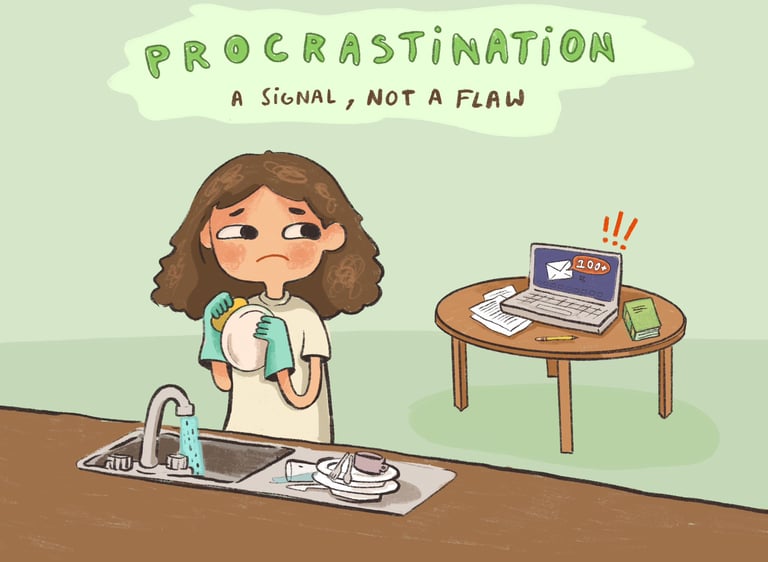
Over time, I’ve come to see procrastination not as an enemy, but as a tool - a signal that our inner defense mechanisms are kicking in.
Before I continue, I must make something clear: I’m not a psychologist, nor have I immersed myself in academic studies on procrastination. I haven’t read much about it, and I don’t intend to. Some insights are worth rediscovering on our own. They serve more as exercises in thought and self-reflection than as groundbreaking findings - sometimes even providing an alternative angle from which to observe the familiar. So, if my interpretation overlaps with existing theories, I apologize in advance - and I invite you to share your perspective so others may learn from it.
What I’ve Learned
Through self-observation, observing others, and countless discussions with friends, colleagues, and partners, I’ve concluded that procrastination can be used as a diagnostic tool for self-reflection.
Procrastination often appears when we face a “heavy” task - whether that means:
Complex problem-solving
Physically demanding work
Time-intensive commitments
Emotionally charged responsibilities
Tasks tied to external evaluation or authority (exams, official reports, project proposals)
Situations involving personal growth, change, or uncertain outcomes
When such tasks arise, our mind and body sometimes resist, triggering the urge to procrastinate. In my experience, this urge often comes from one (or more) of these core conditions:
Physical or mental exhaustion - You simply don’t have the energy to tackle the task.
Time shortage - You don’t have enough time right now to address the challenge properly.
Emotional depletion - You lack the emotional strength or motivation to engage.
Authority confrontation - Facing tasks tied to external judgment can feel threatening and restrictive.
Fear of change or failure - Often linked to transitions, this fear emerges when we’re about to gain something new - whether it’s knowledge, recognition, or constructive criticism. Instead of embracing it, we sometimes twist it into negative thoughts: What if I’m not enough? What if I fail? What if I disappoint others or myself? In such cases, procrastination keeps us in our well-established comfort zone - safe from these thoughts, but also shielded from the potential to grow.
The Trap
The tricky part about procrastination is that we often replace the task with something that feels meaningful - reading articles, watching “educational” videos, helping others, or getting involved in someone else’s problems. On the surface, these activities seem productive, but they prevent us from resting, resetting, and preparing for the real challenge.
This creates a loop: every time we return to the original task, we face the same negative conditions - and the cycle repeats.
Turning Procrastination Into a Tool
If we can recognize the exact moment the urge to procrastinate appears, we can try to identify which of the above conditions is at play and what underlying need it signals.
Exhaustion - Take a conscious break to rest. Sometimes, physical activity followed by early sleep can help reset the mind.
Time shortage - Accept that you don’t have enough time today. Commit to starting fresh tomorrow, and do one small preparatory step now to make it easier.
Emotional depletion - Treat this seriously. Burnout and loss of motivation require attention before any deadline or obligation. Set a near-term reset date - perhaps a month ahead - and keep it. Use that time to reflect, re-strategize, and realign your priorities.
Authority confrontation - Break the task into small, controllable actions so it feels less like an “official judgment” and more like a personal project.
Fear of change or failure - Recognize fear as a sign that something new is about to enter your life. Accept it as part of growth, and consciously steer it away from negative thoughts toward curiosity and preparation.
Regardless of the trigger, the key is to create a new condition that allows you to return to the task with clarity and energy.
The Takeaway
Procrastination is not just wasted time - it’s a signal from your brain that you are approaching some kind of a limit and need to pay attention to yourself. If you can slow down, observe the trigger, and understand the underlying need, procrastination becomes less of a flaw and more of a guide.
In the end, it’s not about eliminating procrastination, but about listening to what it’s trying to tell you - and then responding with intention.
Conect
© 2025 ASAP-Concept d.o.o. All rights reserved.